


2026 is shaping up to be a remarkably strong year for Hindi streaming fiction originals (web-series). In a recent edition of my fortnightly column on MXM India, I wrote about how the first six-and-a-half months of the year have delivered an encouraging mix of shows outside the over-saturated action-crime-thriller, or ACT, cluster. Pritam and Pedro, Made in India: A Titan Story, and Chiraiya are prime examples. Others, such as Taskaree and Raakh, may formally belong to the ACT cluster, but incorporate elements that make them more inclusive across gender and age groups. This is an increasingly important consideration in a category that is rapidly moving from solo viewing to co-viewing, driven by the growth of Connected TV usage across India.
With the content engine beginning to deliver, the next question must be asked: Are these web-series succeeding in widening the audience base for Hindi streaming fiction in India? Are they realising their full potential?
That is more a marketing question than a content question. And the answer, unfortunately, is no.
The Analysis
Ormax Stream Track monitors audience awareness and sentiment towards new streaming originals, beginning with the launch of their marketing campaigns, typically two to three weeks before release, and continuing until four weeks after launch. Several articles on this website have used data from Ormax Stream Track to analyse its key parameters, including Buzz, Appeal and Potency. A recent analysis, for example, highlighted the counter-intuitive finding that non-franchise series featuring female protagonists generate higher Buzz than those led by male protagonists.
For this analysis, we turn our attention to another Ormax Stream Track parameter: Reach.
Reach is defined as the percentage of the audience that is aware of the name of a show. In other words, respondents must say “yes” when asked whether they have heard of a particular title. Reach therefore captures how widely a campaign has penetrated among regular OTT audiences. It is different from a media planner’s conventional definition of reach because, in this case, mere exposure is not enough. The name of the show must have registered with the audience.
For this analysis, we examined the top 40 non-franchise Hindi SVOD fiction series launched since January 2025 and tracked their average Reach week by week. Franchise shows were excluded because subsequent seasons benefit from the awareness already created by earlier seasons.
The red line in the chart below depicts the week-on-week movement in the average Reach of these 40 web-series. For comparison, we have also plotted (in blue) the corresponding average Reach of the top 40 non-franchise Hindi theatrical films released since January 2025.
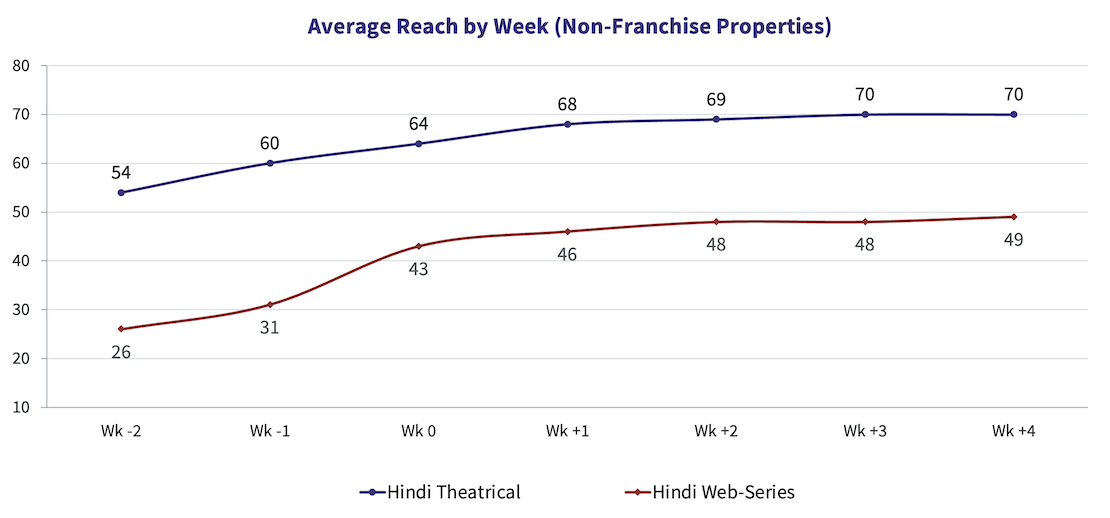
The wide gap between theatrical films and web-series tells a compelling story. In the week of launch or release, referred to as Wk 0, the average Reach of web-series is 33% lower than that of theatrical films. More importantly, the gap does not narrow meaningfully over time. Even four weeks after release, the average Reach of the top 40 non-franchise Hindi SVOD web-series stands at 49%. This is 30% lower than the corresponding figure of 70% for non-franchise Hindi theatrical films.
Since January 2025, only seven of the top 40 web-series have managed to achieve a Reach of 60% or more even once in any of the weeks. These are The Ba***ds of Bollywood, Pritam & Pedro, The Royals, Matka King, Mandala Murders, Chiraiya, and The Hunt – The Rajiv Gandhi Assassination Case. Only two of them, The Ba***ds of Bollywood and Pritam & Pedro, have crossed the 70% mark.
The equivalent numbers for the theatrical category are 25 films above 60% Reach and 17 films above 70%. The comparison is not particularly flattering for streaming.
One could argue that theatrical films enjoy stronger consumer pull for several reasons, including star power and the out-of-home, experiential nature of cinema. But that argument is not entirely convincing, especially when we are discussing SVOD series created to attract new subscribers or retain existing ones. For nearly a decade, beginning with the launch of Sacred Games in 2018, the streaming category has looked towards Hindi cinema for talent, scale and inspiration. Some of India’s biggest streaming series have been produced and directed by accomplished film personalities, while several major cinema stars have headlined them. It is therefore difficult to argue that streaming and cinema belong to entirely separate marketing universes whenever the comparison becomes inconvenient.
The question, then, is what explains this difference?
In our understanding, it comes down to one specific factor: the trailer.
The Trailer
It took the Hindi film industry some time to recognise the trailer as the single most important creative asset in a film’s marketing campaign. But over the last three or four years, that understanding has become firmly established.
Film campaigns once relied on a wide assortment of activities: paid PR (“Medianet”), newspaper and television interviews, reality-show appearances, city tours featuring the stars, outdoor advertising, radio integrations, and almost anything else that could be fitted into the actors’ calendars.
Much of this activity was fundamentally ineffective. Data from The Ormax Bollywood Audience Report over the last decade and a half has consistently shown that the main trailer is the key decision-making point for prospective audiences. Almost everything else can, at best, support it. Songs can play an important role for certain genres, especially romance and musicals. Point-of-sale visibility, including promotion inside cinemas and on ticketing apps, can also provide legitimate support. But the trailer remains the campaign’s central asset.
At a time when more than 95% of Hindi film audiences are highly active on social media, distributing a strong trailer to the intended audience is easier than ever, despite the clutter. A large linear television campaign, for example, is no longer essential. That is a substantial marketing budget saved before the campaign has even properly begun.
Some peripheral marketing activities continue to feature in film campaigns, but their role has reduced considerably. Smarter producers have increasingly learnt to place greater reliance on the main trailer, investing time and effort in getting it right within the limitations of what the film itself has to offer. The trailer cannot, of course, manufacture a better film. But it can ensure that the best available version of the film’s promise reaches the audience.
The same clarity is not yet visible in the web-series category.
Most web-series do have trailers, but the trailers often do not receive the media visibility they require. Campaigns quickly move towards ancillary assets such as shorter promos, influencer integrations, podcasts and social-media content. Some of these asset types may have merit for franchise shows, where the characters and the fictional world have already been established in an earlier season. For non-franchise shows, however, they can become distracting and even confusing.
Campaign windows also tend to be shorter. Some fairly mainstream web-series release their trailers barely one or two weeks before launch and then rapidly move on to other video assets. The trailer is rarely given enough time, visibility or repetition to reach and register with the audience it is meant to attract.
The lack of conviction in the importance of trailers is also visible in the creative output. Many streaming trailers resemble television promos more than theatrical trailers. They are shorter, less dramatic and less inviting. They often make little effort to establish the world in which the story is set, or work hard to explain why audiences should invest six to ten hours of their time in it.
That is a significant commitment to seek from an audience. It may also extend to several more hours across future seasons, assuming the first season performs well enough to earn another one. Yet the trailer tasked with initiating this long-term relationship is often treated like a routine promotional asset.
Another indicator of the difference between the importance assigned to trailers in theatrical and streaming marketing is the incidence of trailer testing. Ormax Campaign Express, our tool for testing trailers and other marketing assets, is equally available to both categories. The film industry uses it actively. The most common use case is to test two potential trailer edits and run with the one that is more effective.
Usage of trailer testing within streaming remains minimal, even though streaming platforms extensively test other aspects of their content, including concepts, scripts, and episodes. For every five trailer-testing projects we conduct for theatrical films, we conduct only one for streaming.
The reason most commonly offered is that the trailer is not ready early enough to be tested, or that there are too many creatives to test. This is exactly how the linear television industry operated for many years. New-show campaigns often consisted of multiple promotional assets being released in quick succession, with the hope that one or two would eventually stick.
For a daily-consumption, habit-driven medium, that approach had at least some logic. In streaming, where the objective is often to attract or retain paying subscribers, the marketing approach must be event-led rather than habit-led. In that respect, streaming is much closer to cinema than to linear television.
Eventification
A good trailer should be able to eventify a film or a show, especially when it is not part of an established franchise or fictional universe. It should create anticipation around the release and generate a sense of urgency to watch it. Social-media posts, influencer conversations, podcasts and outdoor hoardings do not usually achieve this on their own. They can aid recall and reinforce awareness, but they rarely create urgency.
The data above suggests that they are not particularly effective at building Reach either.
A significant proportion of streaming-marketing activity takes place after release, once audience word of mouth begins to emerge. But even at this stage, a strong trailer remains a critical asset.
Suppose someone recommends a show enthusiastically and tells you that you must watch it. You may immediately open the app and begin watching, but only if you already subscribe to the platform, and trust the recommender completely. That combination may not be especially common.
The more likely response is that you search for the trailer, watch it and then decide whether the recommendation is worth your time and, in many cases, your money. A weak trailer can still turn a strong recommendation into a negative decision.
A good trailer eventifies the film or show it is promoting. A viral social-media campaign can ride on that eventification, amplify it and perhaps even add momentum to it. But it can rarely replace the trailer in effectiveness.
In Conclusion
The Hindi film industry has become a convenient punching bag for many things, often with good reason. A sizeable proportion of the content it produces can be basic or mediocre, and audiences are understandably unforgiving in an environment saturated with content and entertainment options. But one thing the Hindi film industry has begun to get right in recent years is focused and effective marketing.
Streaming is currently enjoying a year in which its content story looks stronger than it has in a long time. But an average Reach of less than 50%, even four weeks after launch, cannot be considered a satisfactory marketing outcome.
Investing in strong trailers, and then backing them wholeheartedly as the single most important asset in the campaign, is a lesson that streaming platforms can certainly learn from film marketing.
Good content deserves a good campaign. And for a new web-series, that campaign must begin with a trailer strong enough to make the audience feel that missing the show would actually mean missing out.

K-Dramas in India: The growth story in numbers
Nine key data points from The Ormax OTT Audience Report: 2026 and Ormax StreamView, that showcase the growing consumption of K-Dramas in India
The Ormax OTT Audience Report: 2026
The latest edition of The Ormax OTT Audience Report sizes India’s digital video universe at 664.9 million users. The CTV universe has grown by a staggering 60% in a single year, to 206.9 million
The Connected TV Era: India's New Prime Time
A new report by WPP Media and The Trade Desk, in partnership with Ormax Media, explores India’s rapidly-evolving CTV landscape, and what that means for marketers today
Subscribe to stay updated with our latest insights
© 2026 Ormax Media Pvt. Ltd. All Rights Reserved.
Ormax Media Pvt. Ltd.
402, Signature,
Captain Suresh Samant Marg,
Andheri West, Mumbai 400053
Phone: +91 9324939911
Get to know us


We use cookies to improve your experience on this site. To find out more, read our Privacy Policy