


For an industry that spends a fair amount of time trying to predict what audiences will watch next, Hindi cinema has just been handed another reminder that audiences did not attend the meeting. Hanuman Ansh has emerged as one of the most extraordinary box office stories of 2026. With India gross collections of ₹400 Crore (read our latest India box office report here), it is the second-highest-grossing film of the year, behind Dhurandhar: The Revenge. Coming just a year after the huge success of Mahavatar Narsimha, it is becoming increasingly difficult to dismiss devotional cinema as an occasional aberration.
Two films do not make a genre boom, of course. But they are enough to make producers take notice. The more interesting question is whether these successes indicate the emergence of a viable theatrical category, or whether they are exceptional outcomes driven by factors that may not be easily replicated.
An established category, but an underserved theatrical market
Television discovered the power of devotional content decades ago. From mythological serials to devotional channels, festival programming and religious music, faith has remained a remarkably durable entertainment category. Even YouTube has an enormous devotional ecosystem, where spiritual discourses, bhajans and religious storytelling attract substantial consumption.
Cinema, however, largely vacated this space. Jai Santoshi Maa became a phenomenon in 1975, but devotional films subsequently moved away from the mainstream Hindi theatrical business. Religion continued to feature prominently in cinema, but more often through a temple scene, a song, or a hero receiving divine assistance shortly before the climax. What seems to be changing now is that devotion itself can once again be the main event.
The popularity of devotional programming on television and digital platforms establishes that there is an audience for the category. It does not, however, establish that this audience will pay to watch the same category in theatres. The success of Mahavatar Narsimha and Hanuman Ansh demonstrates that such conversion is possible, under the right circumstances. The industry needs to understand what those circumstances are, rather than concluding that devotional content is inherently theatrical.
Understanding potential demand drivers
There are several reasons why devotional films can make commercial sense. The first is familiarity. Devotional and mythological stories arrive with something most films spend crores trying to create: pre-existing awareness. Audiences know the characters, symbols, values and emotional universe. The marketing department does not have to explain everything from scratch.
However, awareness is only the first stage of the theatrical consumption funnel. A familiar subject still needs to generate interest in a specific cinematic interpretation, followed by the intent to purchase a ticket. The gap between knowing a religious personality and wanting to watch a film about that personality can be considerable.
Second, faith lends itself unusually well to collective viewing. A devotional film is not necessarily an individual entertainment choice. Families can watch together, older audiences can participate more actively in theatrical consumption, and word-of-mouth can travel through social and community networks that conventional film marketing rarely reaches. The chart below depeicts the accompaniment profile of Hanuman Ansh, in comparison to the top Hindi films of 2026. Accompaniment profiles are based on post-release surveys, where theatrical audiences are asked whom they watched the film with. Hanuman Ansh not only has a stronger family-skewed accompaniment profile than the overall category profile on the left, but its 33% share of family accompaniment is also the highest across all films released in 2026. No other film has touched the 30% mark.
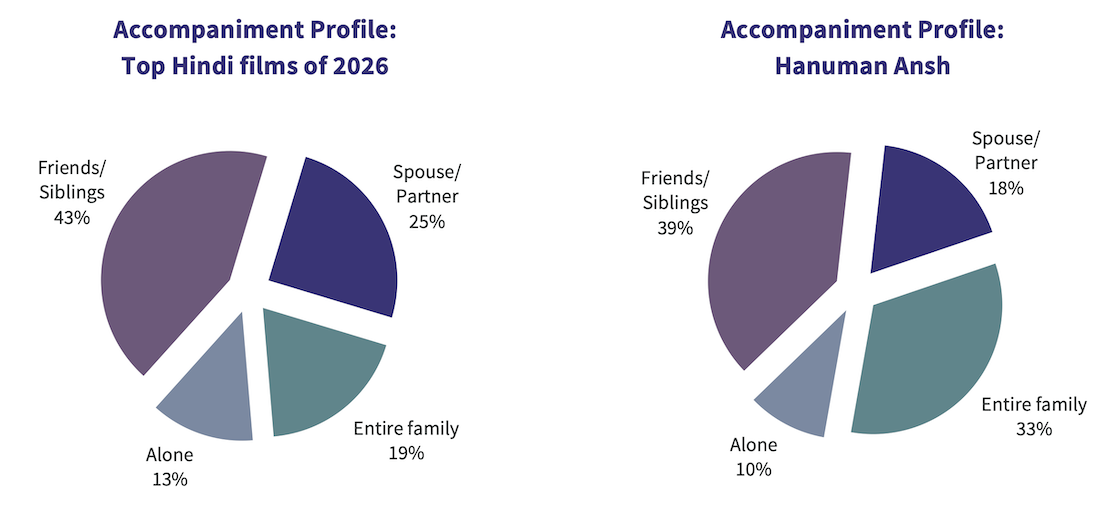
This also creates the possibility of expanding the theatrical audience beyond regular moviegoers, which is evident in the case of Hanuman Ansh, judging by the much older age profile of its audiences, in a category that's largely driven by 15-34 year old audiences.
There is also the potential for a distinct marketing model. For conventional theatrical films, awareness and interest are typically built through trailers, songs, stars, advertising and publicity. Devotional films can additionally benefit from established communities of followers, religious institutions and interpersonal recommendations.
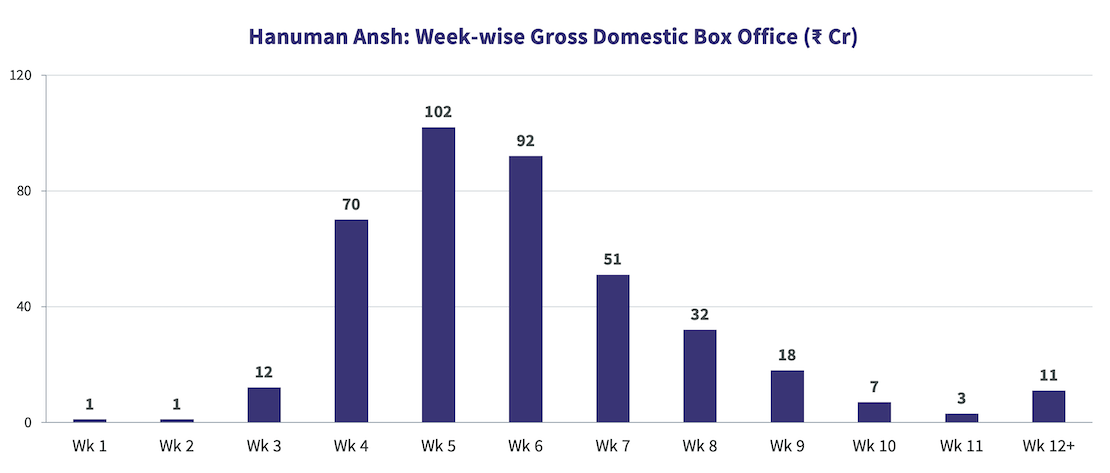
Hanuman Ansh is an interesting example. Its early traction came from the core followership of the personality whose biopic it is. This provided a starting audience that did not necessarily have to be acquired through conventional film marketing. The wider box office success, however, required the film to move beyond that initial audience base. The week-wise box office movement of the film, seen in the chart below, is highly unusual, with a peak in the fifth week, underlining the unique nature of the film's box office trajectory.
There is also a significant element of under-supply. For years, the Hindi theatrical market has offered audiences endless variations of action, romance, comedy and thrillers, while a sizeable appetite for faith-based storytelling has largely been serviced elsewhere. When supply finally arrives, pent-up demand can produce results that look disproportionate to conventional indicators such as star power, production budget, or opening-day buzz.
But under-supply does not automatically imply unmet theatrical demand. Some categories work particularly well as habitual television or digital consumption, without creating an equivalent willingness to spend money on a cinema ticket. The two recent successes show that devotional cinema can overcome this barrier. Whether it can do so consistently is an entirely different question.
Different categories within faith-based cinema
Mahavatar Narsimha was an especially interesting example because animation, traditionally a difficult theatrical format in India, did not prevent audiences from engaging with the story. Hanuman Ansh goes further in another direction: it demonstrates that a devotional film does not necessarily need to arrive disguised as a giant spectacle.
But some distinctions are important. Films such as Hanu-Man, Kantara and Kalki 2898 AD have already demonstrated the commercial power of stories that draw from mythology, faith and cultural identity. They are not quite the same thing as devotional cinema. Their primary grammar remains that of mainstream commercial entertainment, with mythology providing the larger universe.
Ramayana, releasing this Diwali, represents yet another version of the opportunity. With major stars, enormous scale and blockbuster economics, it is mainstream mythology designed as event cinema. Its ambition is fundamentally different from the smaller devotional film that grows through faith-driven word of mouth. Both can benefit from the same cultural currents, but they are not interchangeable products.

From a content strategy perspective, treating all these films as a single genre would therefore be misleading. A mythology-inspired action film, an animated adaptation of a religious narrative, and a biopic of a spiritual personality may have significantly different audience motivations, demographic profiles and commercial trajectories. Even within devotional cinema, the appeal of one personality or religious narrative cannot be assumed to transfer to another. Familiarity, emotional connection and theatrical interest need to be evaluated independently for each proposition.
The challenge of replicating organic success
Which brings us to the inevitable next phase: everybody making one.
Hindi cinema has an enviable ability to identify an emerging opportunity and then attempt to eliminate it through over-supply. If two devotional films work, 20 proposals involving gods, saints and spiritual figures cannot be far behind. But that would be a mistake.
In fact, 2026 itself provides a useful counterpoint to the Hanuman Ansh success story. Another film based on the same spiritual personality, titled Shree Baba Neeb Karori Maharaj, released in April this year and sank without a trace, with lifetime box office of less than ₹15 lakh. The contrast could not be more instructive. If two films about the same subject can deliver such dramatically different outcomes, the subject alone clearly cannot explain commercial success.
This is where the distinction between category potential and project-level viability becomes critical. A successful film can demonstrate the existence of an audience, without establishing that the audience will turn up for every film in that space.
Box office performance in the category also needs to be examined beyond lifetime collections. The relationship between opening-weekend and lifetime business, the pace of word-of-mouth growth, geographical concentration, and the contribution of repeat or infrequent moviegoers can help identify whether a film's success was primarily driven by an established audience base or by broader organic adoption.
The latter is particularly difficult to engineer. Marketing can create awareness and stimulate initial interest. It cannot guarantee that audiences will develop an emotional connection with the film, recommend it within their communities, or transform it into a wider cultural phenomenon. Both Mahavatar Narsimha and Hanuman Ansh scored exceptionally well on audience appreciation, evident from their extremely high Ormax Power Rating (OPR) scores of 86 and 84 respectively, at par with Dhurandhar: The Revenge (87) and Dhurandhar (86). These are the four most-liked Hindi movies since the start of 2025, based on OPR, an audience engagement metric used extensively in Ormax Media's content testing work.
Implications for the industry
The success of devotional cinema is not evidence that anything with a religious subject will work. Faith may provide awareness and emotional entry, but audiences will still respond to storytelling, authenticity, music, visualisation and, perhaps most importantly, sincerity. A genre built around belief can probably detect cynicism faster than most.
For producers evaluating new projects, the starting point should therefore be the strength of the specific content proposition, rather than the recent box office performance of the category. Audience research (script testing in particular) can help distinguish between familiarity and interest, between religious affinity and theatrical intent, and between the appeal of a subject and the appeal of its proposed treatment.
Because the gods may be generous. But they are unlikely to underwrite every Friday.

The India Box Office Report: September 2026
Powered by Mirzapur: The Movie, September 2026 crossed ₹1,100 Cr at the India box office, taking the year’s total to ₹11,000 Cr with three months to go

Ormax Cinematix's FBO: Accuracy update (September 2026)
This edition of our monthly blog summarises Ormax Cinematix's box office forecasts (FBO) for all major September 2026 releases vis-à-vis their actual box-office openings

The India Box Office Report: August 2026
Driven by Hanuman Ansh, Toxic & Irumudi, August 2026 emerged as the best month of the year so far at the India Box Office, grossing ₹1,768 Cr
Subscribe to stay updated with our latest insights
© 2026 Ormax Media Pvt. Ltd. All Rights Reserved.
Ormax Media Pvt. Ltd.
402, Signature,
Captain Suresh Samant Marg,
Andheri West, Mumbai 400053
Phone: +91 9324939911
Get to know us


We use cookies to improve your experience on this site. To find out more, read our Privacy Policy