


Spider-Man: Brand New Day opened in India to almost ₹75 Cr gross (₹ 60 Cr nett) on its first day, making it the biggest opening ever for a Hollywood film in the country, surpassing the first-day record held by Avengers: Endgame (2019). The film subsequently went on to gross more than ₹600 Cr at the Indian box office over its lifetime, making it the highest-grossing Hollywood film in India of all-time, surpassing Avatar: The Way of Water (2022).
The record-breaking opening of the film underlines the effectiveness of its India marketing campaign, which also reflects in how the film tracked on Ormax Cinematix.
Record performance on Ormax Cinematix
Ormax Cinematix (OCX) is our campaign tracking and first-day box office forecasting tool, available in seven language variants, including Hollywood films. OCX reports three audience parameters, namely Buzz, Reach and Appeal, captured using primary research, with a weekly sample size of 2000+.
Buzz refers to the unaided recall of the film, i.e., % audience who named the film, when asked to name as many upcoming films as they could, in the Hindi language in this case. Buzz is a strong indicator of the talk value of the film, i.e., the degree and effectiveness of conversations around the film among theatre-goers. This is the parameter of focus in this article, and we shall return to it shortly.
Reach refers to the awareness of the films, i.e., % audience who have heard the name of the film. Reach captures how wide the film has managed to penetrate among theatre-goers. Most franchise films manage to score 90%+ on Reach, and Spider-Man: Brand New Day was no exception, registering a Reach of 90%+ through its entire tracking period of eight weeks, and finishing with 99% Reach in the week of release.
Appeal is a metric that reports % audience who have a definitive intention to watch the film in a theatre, among those aware of the film. Appeal is a strong indicator of the creative strength of the campaign, i.e., the collective pull of the franchise equity, theme, genre, starcast, and other such aspects, as communicated via the campaign. Spider-Man: Brand New Day recorded an Appeal of 90%+ through its campaign period, peaking at 96% in its release week, which is a notch better than previous record holders Avengers: Infinity War (95%) and Avengers: Endgame (92%).
The Buzz factor
While high Reach and Appeal are creditable outcomes, they are not unheard of in context of mainline Hollywood franchises, such as the big Marvel Cinematic Universe (MCU) films, or the Avatar films. However, it is on Buzz that Spider-Man: Brand New Day outperformed other big Hollywood films by a significant margin.
In 11 years of Ormax Cinematix tracking for Hollywood films, only five films have managed to register a Buzz of 70% or more in their release week. The chart below depicts the week-on-week Buzz of these five films, from Wk -3 (three weeks before release) to Wk 0 (the week of release).
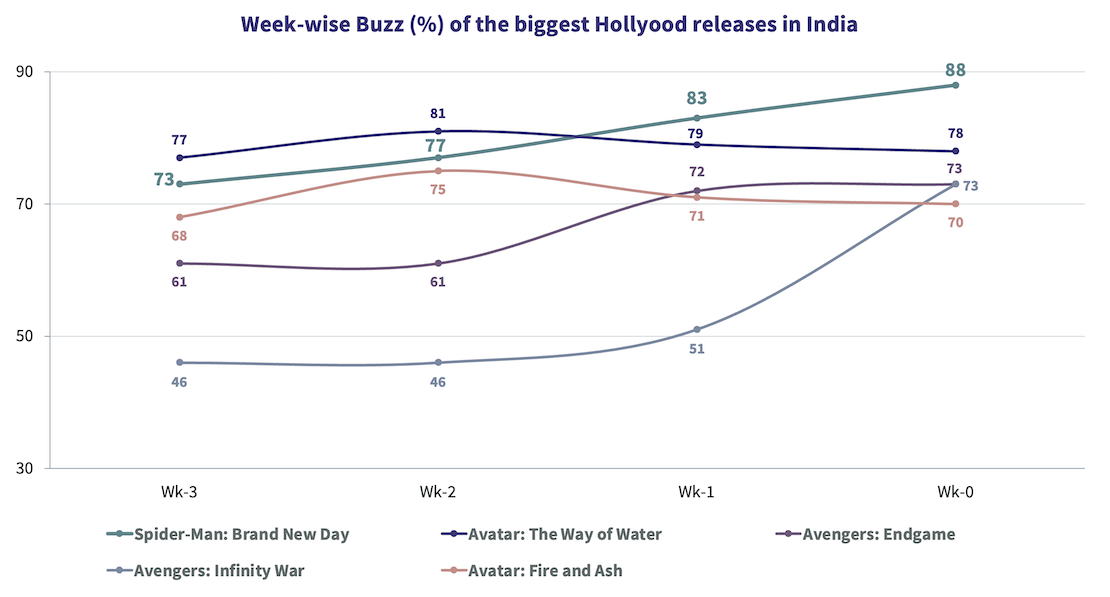
With a release-week Buzz of 88%, Spider-Man: Brand New Day (in green in the chart above) didn’t just set a new record; it broke the previous one emphatically, by 10 percentage points. The real difference came in the last two weeks (Wk -1 and Wk 0), when the Buzz took off from the already-high level of 77% in Wk -2, to 83% in Wk -1 and then 88% in the release week.
The Buzz boost the film saw in the two weeks leading to its release can be attribute to a highly effective marketing campaign that didn’t rely only on the standard video assets like the film’s trailer, but extended the audience engagement across media through various innovative activations and integrations. It’s this Buzz boost that may have added ₹8-10 Cr to the film’s first-day box office, if not more.
Big-ticket franchise films are often seen as “easy to market” But the huge opening of Spider-Man: Brand New Day underlines how even with the strongest of properties, there is potential for innovative marketing that can help the film outperform. Here’s a look at some of the most interesting and effective marketing initiatives undertaken by the film in India.
Localizing Spider-Man through cultural collaborations
A significant part of Spider-Man: Brand New Day’s marketing effort was focused on localizing the Spider-Man brand, and converting that relevance into theatrical footfalls. And this also reflected in the film’s language mix. 45-50% of its opening came from language dubbed versions, compared to 35-40% for the top 10 Hollywood films in India on an average. This suggests that the campaign was successful in broadening the film’s acceptance beyond the traditional English language audience, and activating audiences across India’s language markets.
Compared to other global superheroes, Spider-Man has been more firmly embedded in Indian popular culture for a while now. The Cockroach Janta Party protests, where Spider-Man was a frequently-featured character, are a reflection of Spider-Man’s cultural salience.
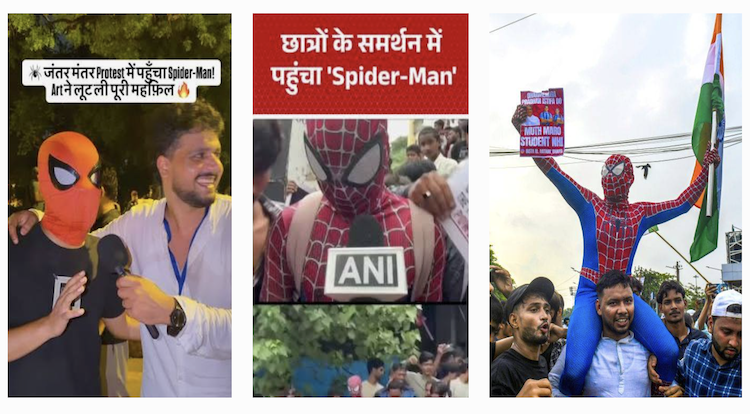 Spider-Man: Brand New Day’s campaign recognized this strength, and strategically amplified it. The localization strategy went beyond simply dubbing the film’s trailer into Indian languages. The campaign sought to embed Spider-Man within familiar Indian cultural contexts, using local entertainment, personalities and content formats to make the character feel culturally proximate to Indian audiences.
These collaborations included a cameo in Taarak Mehta Ka Ooltah Chashmah, where Spider-Man entered Gokuldham Society and was playfully referred to as ‘Sanskari Spider-Man’; a cricket-led campaign with KL Rahul and Suryakumar Yadav, that connected Peter Parker's story with their own experience of fame and public recognition; and regional activations such as Rishab Shetty fronting a Kannada promotion, and a dedicated Tamil anthem by G.V. Prakash Kumar and rapper Vengayo.
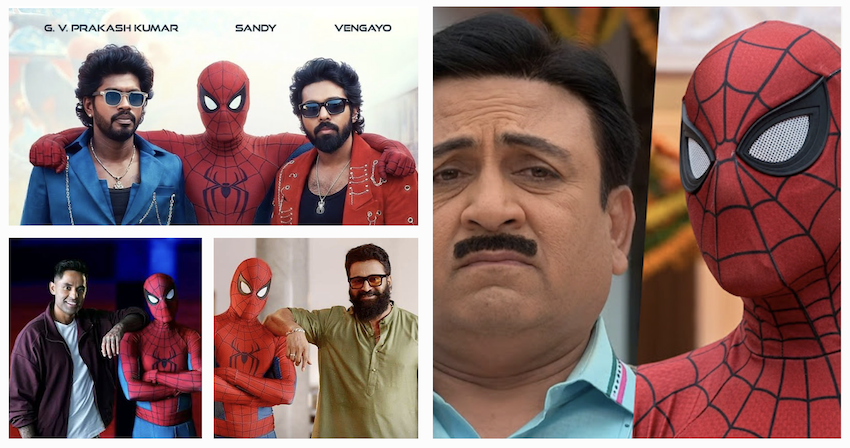
The effectiveness of these interventions lay in their ability to combine the familiarity and cultural credibility of established Indian entertainment properties with the equity of the Spider-Man franchise. Bringing in leading personalities across markets not only drove visibility, but also reinforced the proposition of experiencing the film in one’s language of comfort, helping position the original and dubbed versions on an equal footing. The campaign brought Spider-Man into entertainment worlds that audiences were already familiar and comfortable with, reducing the cultural distance between a Hollywood franchise and the Indian theatrical audience.
Capitalizing on the marketing muscle of consumer brands
The localization strategy was complemented by a broad set of consumer and entertainment integrations, taking Spider-Man beyond traditional film media. McDonald’s created a Spider-Man meal and Spider-Man merchandise, Fevicol MR introduced limited-edition packs with QR-led craft content, and more than 20 other brands brought Spider-Man merchandise into the retail and cinema ecosystem. Beyond the visibility generated by these partnerships, they gave Spider-Man access to the distribution muscle and existing consumer relationships of these brands, particularly helping extend the franchise into parent-and-child consumption occasions.

Using innovation to drive theatrical worthiness
Innovation further helped create high-visibility and participation-led moments around the release. A 3D Spider-Man installation in Mumbai turned an outdoor billboard into a spectacle, while the BGMI collaboration brought Spider-Man into the gaming environment. Fan-created hoardings around Tom Holland’s Mumbai visit further extended the character into organic fan culture.
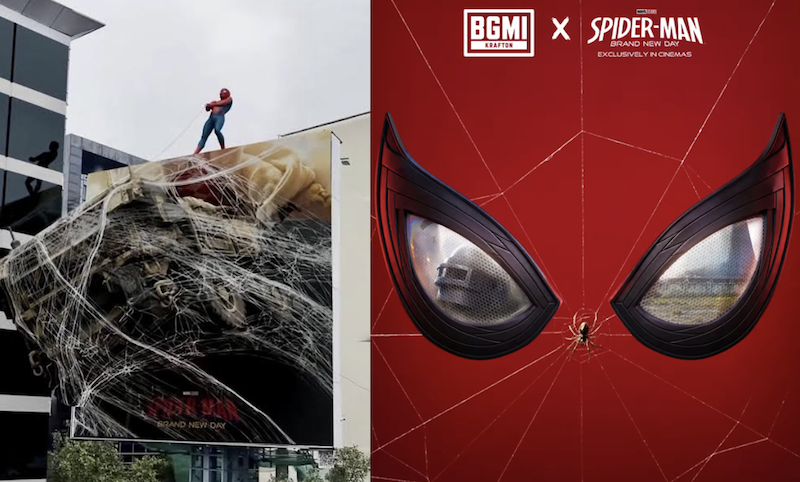
Importantly, these innovations also leveraged the visual strengths of the Spider-Man property, using spectacle, scale and immersive formats to showcase what audiences could experience on the big screen. This reinforced the film’s theatrical worthiness, an increasingly important consideration in the post-pandemic environment, where films need to offer a compelling reason to be experienced in cinemas rather than be simply consumed at home.
In conclusion
The story of Spider-Man: Brand New Day’s marketing success in India is ultimately one of activating existing franchise equity to generate a broader theatrical pull. By going beyond conventional Hollywood marketing and taking Spider-Man into local languages, Indian culture, everyday consumer occasions and innovative experiences, the campaign expanded the franchise beyond its core fandom and converted existing equity into stronger talk value and a record-breaking theatrical opening. A famous dialogue from the franchise goes, ‘With great power comes great responsibility’. For event tentpole films, that responsibility is to bring new audiences into the fold of theatrical viewing, especially in a market where less than 15% of the country watches films in theatres. In that sense, Spider-Man: Brand New Day demonstrates how a global franchise can use local relevance and innovation not just to serve existing fans, but to expand the theatrical universe.

Ormax Cinematix's FBO: Accuracy update (September 2026)
This edition of our monthly blog summarises Ormax Cinematix's box office forecasts (FBO) for all major September 2026 releases vis-à-vis their actual box-office openings

The India Box Office Report: August 2026
Driven by Hanuman Ansh, Toxic & Irumudi, August 2026 emerged as the best month of the year so far at the India Box Office, grossing ₹1,768 Cr

Ormax Cinematix's FBO: Accuracy update (August 2026)
This edition of our monthly blog summarises Ormax Cinematix's box office forecasts (FBO) for all major August 2026 releases vis-à-vis their actual box-office openings
Subscribe to stay updated with our latest insights
© 2026 Ormax Media Pvt. Ltd. All Rights Reserved.
Ormax Media Pvt. Ltd.
402, Signature,
Captain Suresh Samant Marg,
Andheri West, Mumbai 400053
Phone: +91 9324939911
Get to know us


We use cookies to improve your experience on this site. To find out more, read our Privacy Policy